Antique Japanese Soroban Abacus
Traditional wooden soroban · Meiji to Taishō period (c. 1890–1920).
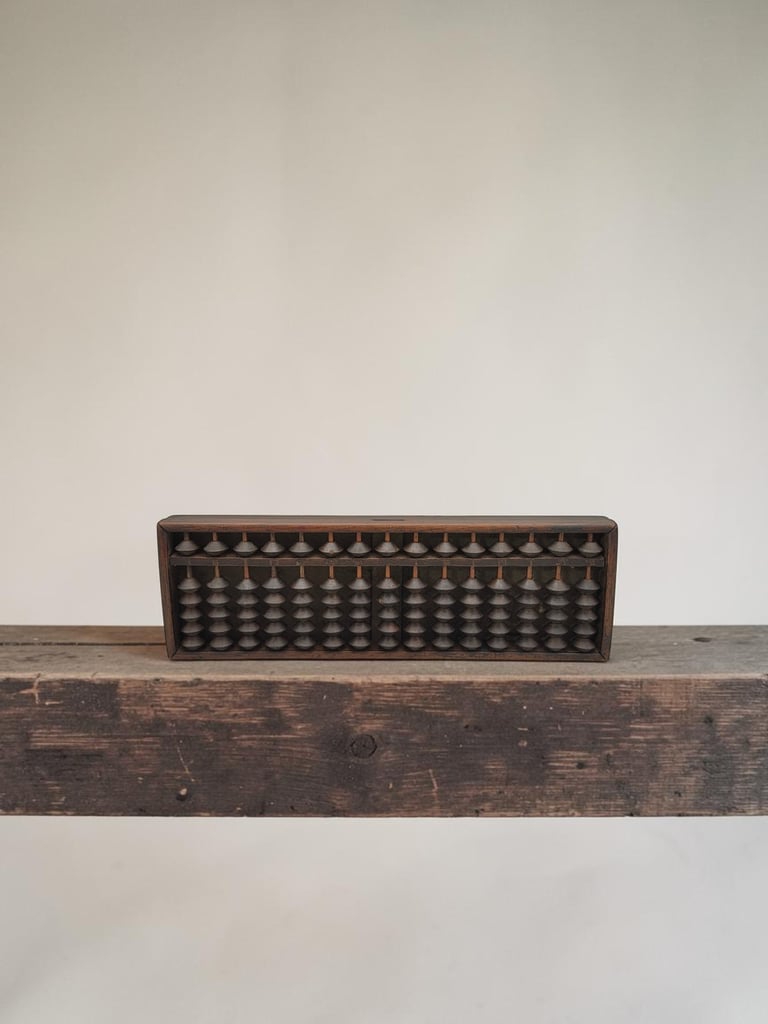
This antique Japanese soroban abacus was sourced in Japan and selected for its craftsmanship, history, and quiet presence.
ABOUT THIS PIECE
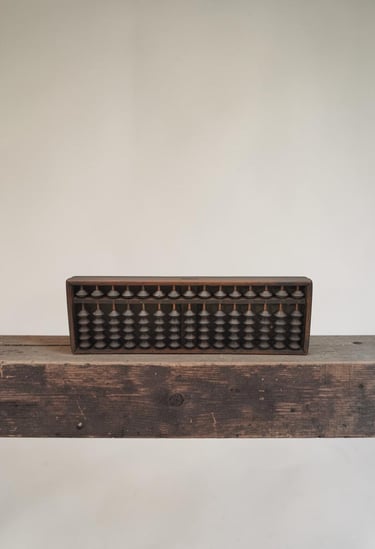
This antique Japanese soroban features the transitional 1:5 bead configuration, with one upper bead and five lower beads per rod. This format reflects a moment of evolution in calculation tools, bridging earlier Edo-period forms and the simplified modern abacus.
The dense wood frame, likely keyaki (zelkova), shows a rich patina, while the darkened beads bear the marks of repeated handling over time. The contrast between the structure and the worn beads gives the piece a quiet depth, shaped by years of practical use.
CULTURAL NOTE
The soroban was an essential tool in Japan for commerce and daily accounting from the Edo period through the early 20th century. Over time, its structure evolved to improve speed and efficiency, moving from more complex bead arrangements to simplified configurations.
The 1:5 format seen here belongs to a transitional phase during the Meiji and Taishō periods, before the now-standard 1:4 system became widely adopted in the Shōwa era. Instruments like this reflect not only technical evolution but also the rhythm of everyday life and trade.
DETAILS & PRICE
SKU: A145
Price:
Europe: €120 — delivery to Europe included
United States: US$140 — delivery to the USA included
Japan: ¥12,000 — delivery within Japan included
Material: Wood (likely keyaki) and metal rods
Period: Meiji to Taishō period (c. 1890s–1920s)
Origin: Japan
Features:
Older 1:5 bead configuration · darkened beads from prolonged use · hand-carved kanji markings · compact proportions · rich aged wood patina
Dimensions: W 34 × D 11 × H 3 cm (13.4 × 4.3 × 1.2 in)
Condition:
Good antique condition · visible wear, patina and surface marks consistent with age and use · structurally stable
DELIVERY
Delivery is included in the prices shown for Europe, the United States and Japan. For other destinations, please contact us for a delivered price.
Secure, reinforced packaging with tracking.
Note: Import duties or taxes may apply depending on the regulations of the destination country. For items over 100 years old, reduced import duties or taxes may apply in some countries. On request, we can provide a certificate stating the item’s estimated age to assist with customs clearance.
Reserve or enquire about this piece
Each piece is unique.
You may reserve this item or enquire for further details.
We will confirm availability and provide a secure payment link if you wish to proceed.
No payment is required at this stage. Reservations are held for 24 hours.